
Environmental Science Meets Carbon Accounting Software: A Perfect Match


In the push for sustainability, companies have figured out a simple truth: it’s not enough to want to be green; you have to measure everything. Really understanding your carbon impact requires not just good intentions, but hard data and precision. That’s why the latest environmental science software and carbon accounting tools are becoming essential partners.
The most ambitious organizations today are combining solid scientific principles with cutting-edge ESG software to effectively track, analyze, and shrink their environmental footprint. It means data doesn’t just report on sustainability anymore, it drives it.
Let’s dive into how the core science of ecosystems, chemistry, and climatology is now built into the digital platforms we use for emissions monitoring, scientific carbon management, and real-time ESG reporting.
Why Environmental Science Matters in ESG Reporting
Environmental science is the study of how natural systems interact, evolve, and respond to human activity. Its methods like data modeling, statistical analysis, and system monitoring are the same foundations now driving carbon accounting software.
Before advanced tools existed, sustainability officers relied on manual reporting and estimates. But the complexity of today’s carbon ecosystem covering direct emissions (Scope 1), energy consumption (Scope 2), and value chain impacts (Scope 3) requires a scientific approach to maintain credibility and accuracy.
By integrating environmental models into carbon tech software, businesses can:
- Quantify emissions with higher precision
- Identify environmental risks faster
- Simulate future climate impact based on business activities
- Turn ESG data into actionable strategies
This scientific rigor ensures that sustainability reports are verifiable climate impact statements.
Also See: The Importance of Carbon Accounting Certification in 2025
The Science Behind Carbon Accounting Software
Modern carbon accounting innovations operate on scientific models of greenhouse gas behavior, lifecycle emissions, and environmental flow analysis.
Here’s how emissions tracking science works behind the scenes:
1. Environmental Data Collection
Software platforms collect data from multiple sources like energy meters, logistics networks, supplier databases, and industrial sensors. Using principles from environmental monitoring, this data is calibrated to align with recognized emission factors and standardized metrics like IPCC or GHG Protocol.
2. Scientific Conversion Models
Once collected, the data undergoes carbon equivalency conversion which is a process grounded in environmental chemistry and climatology. Each emission type (CO₂, CH₄, N₂O) is assigned a Global Warming Potential (GWP) value to calculate total CO₂e (carbon dioxide equivalent).
3. AI-Powered Environmental Simulation
Advanced carbon tech software integrates AI models to predict emission trajectories and simulate sustainability scenarios. These simulations draw from climate modeling science, projecting how business operations might affect future emission outputs under different variables.
4. Continuous Verification
Environmental science emphasizes reproducibility. Similarly, ESG software tools now include automated auditing features that cross-verify reported data with third-party databases, ensuring transparency and scientific accuracy in carbon data analysis.
This scientific framework ensures that digital sustainability platforms calculate, test, and verify environmental outcomes with academic precision.
How Environmental Science Strengthens ESG Software
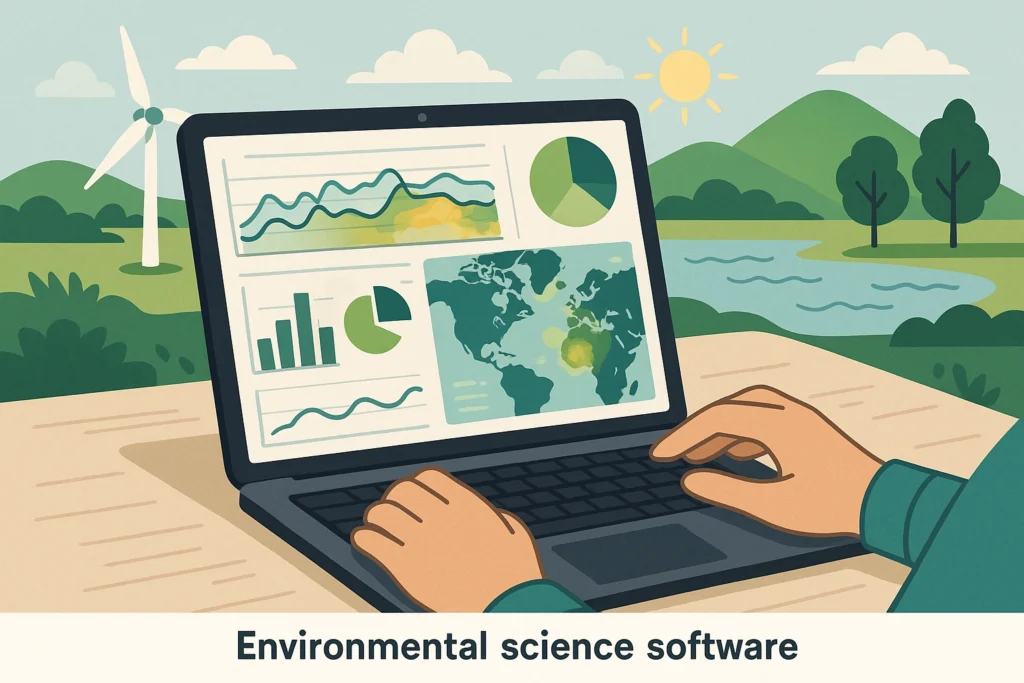
When scientific ESG solutions are embedded into technology, ESG moves beyond compliance to strategy. Here’s how it helps ESG software:
1. Data Accuracy and Traceability
Science thrives on reproducibility. By applying environmental data models, carbon accounting systems can trace every emission back to its source, ensuring audit-ready accuracy for global standards such as the GHG Protocol, ISO 14064, and TCFD frameworks.
2. Predictive Environmental Modeling
Using environmental simulation algorithms, software can project future emissions under various business scenarios helping companies make proactive decisions rather than reactive disclosures.
3. Integration with Ecosystem Data
Environmental science teaches that no system operates in isolation. Modern platforms now pull data from external environmental databases (climate, land use, biodiversity indices), providing a 360° ESG view that connects business actions to ecological outcomes.
4. Dynamic Climate Metrics
Instead of static yearly reports, scientific carbon management tools offer dynamic dashboards that visualize emissions in real-time translating environmental data into strategic insights for executives and sustainability officers alike.
Carbon Accounting Innovations Transforming the Industry

The fusion of environmental science and technology is giving rise to a new class of carbon accounting innovations that redefine sustainability intelligence such as:
1. AI-Driven Carbon Analytics
Machine learning algorithms can now detect anomalies in emission data, forecast reduction potential, and even identify “carbon hotspots” across supply chains. These AI-powered ESG software tools adapt over time, improving prediction accuracy through pattern recognition.
2. Lifecycle Assessment Automation
Traditionally, lifecycle assessments (LCA) were time-consuming and costly. Environmental science software automates the LCA process, calculating cradle-to-grave impacts from raw material extraction to product disposal with scientific precision.
3. Integrated Scope 3 Modeling
Scope 3 emissions often represent over 70% of a company’s footprint. Through emissions tracking science, modern tools integrate supplier data and apply advanced modeling techniques to fill gaps and estimate indirect emissions accurately.
4. Carbon Benchmarking Algorithms
Using carbon data analysis, ESG tools benchmark a company’s performance against industry averages. By applying scientific normalization models, businesses can see how their emissions compare within sector-specific contexts. These innovations collectively drive smarter sustainability.
The Future of Environmental Science Software
The next decade will see environmental science software evolve from data analytics to decision intelligence. Emerging trends include:
Hybrid Data Models: Merging environmental monitoring data with financial metrics for a unified ESG performance score.
Decentralized Carbon Ledgers: Blockchain-based systems ensuring transparent carbon credit tracking and verification.
Behavioral Carbon Analytics: Measuring the human factors influencing sustainability performance, such as employee behavior and policy compliance.
Automated ESG Reporting Pipelines: AI systems generating regulatory-compliant ESG reports instantly from live data feeds.
Climate Digital Twins: Virtual models simulating entire supply chains to predict carbon impact before real-world execution.
This evolution will redefine ESG accountability where every sustainability claim is scientifically measurable, verifiable, and traceable.
Benefits of Environmental Science Software
The convergence of science and software delivers measurable advantages:
Precision: Accurate, standardized emissions measurement aligned with environmental models.
Transparency: Data-backed reporting that builds trust among investors and regulators.
Efficiency: Automated data collection reduces manual effort and reporting errors.
Strategy Alignment: Predictive modeling connects carbon data to financial performance.
Scalability: Cloud-based architecture supports global data integration for multinational organizations.
With these benefits, scientific carbon management becomes a cornerstone of business transformation rather than a compliance burden.
FAQ: Environmental Science Software
What is environmental science software used for?
It’s used to collect, analyze, and model environmental data such as emissions, energy use, and waste to improve sustainability reporting and compliance.
How does science improve carbon accounting software?
It adds accuracy, validation, and predictive modeling capabilities, ensuring emissions data aligns with real-world environmental behavior.
What industries benefit most from carbon accounting innovations?
Energy, logistics, manufacturing, agriculture, and consumer goods and all industries with complex carbon footprints.
Can ESG software tools help meet net-zero goals?
Yes. They provide measurable pathways by tracking reductions, modeling future outcomes, and verifying results scientifically.
Conclusion
The partnership between environmental science software and carbon accounting innovations marks a turning point in sustainability. Frankly, as demands for transparency grow, the only businesses that will stay competitive are those willing to embrace truly scientific ESG solutions.
By fusing deep emissions tracking science with robust carbon data analysis and clear ESG reporting, companies can finally move beyond making vague promises and start delivering concrete proof. In this new landscape, being sustainable isn’t enough; you have to do it with scientific precision and show a real, measurable impact.